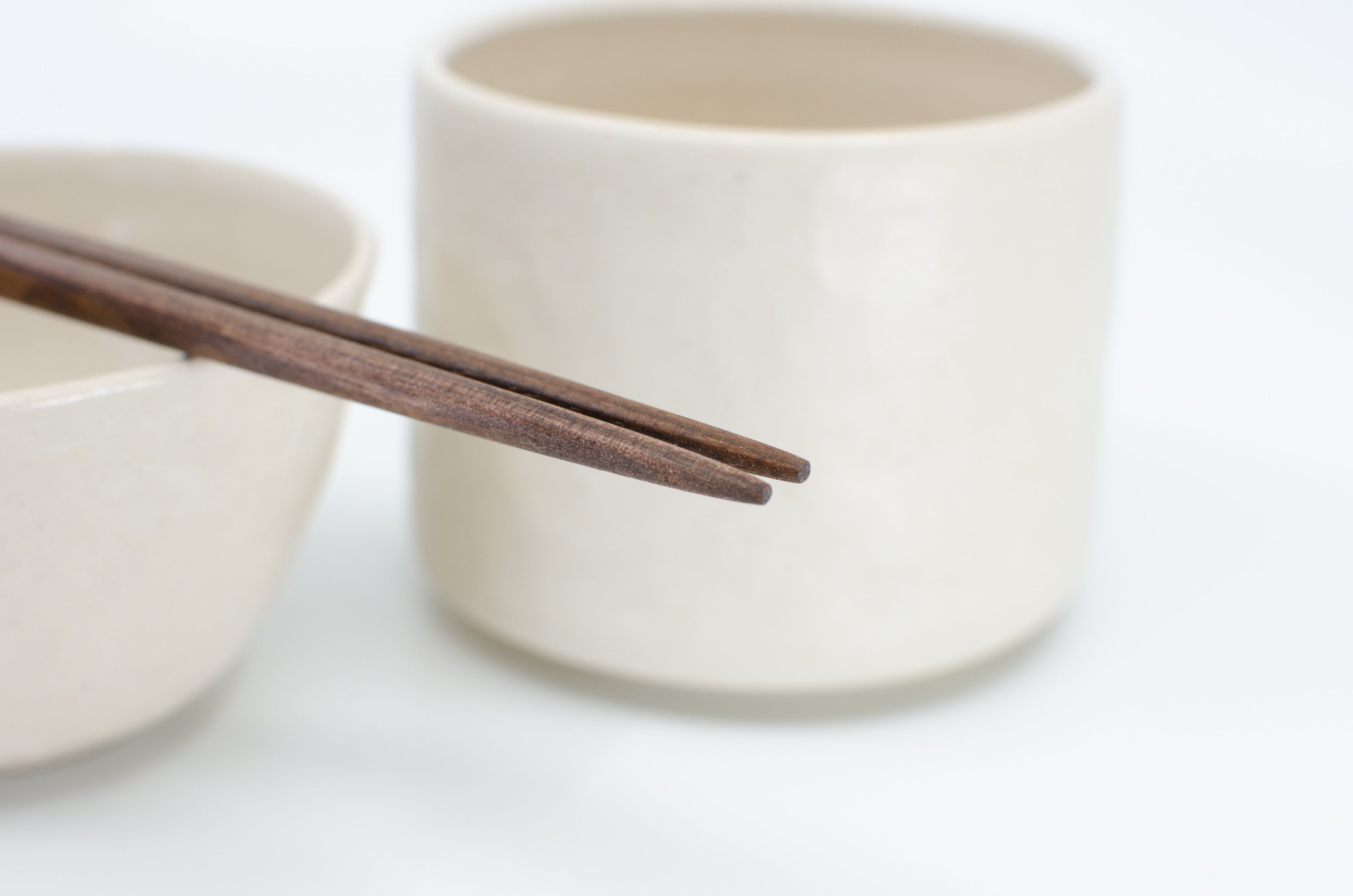

When choosing a wooden kitchen tool, we tend to focus on what we can see.
The colour. The grain. The weight in our hand.
But there’s another question worth asking:
Where did the wood come from?
Teak and walnut are both beautiful hardwoods, and both can make exceptional kitchen tools. But they arrive in your kitchen through very different journeys.
Understanding those differences can help you choose not just a beautiful piece of wood, but one that aligns with what matters to you.
Why Teak Has Such a Great Reputation
Let’s start by giving teak the credit it deserves.
Teak (Tectona grandis) is an extraordinary wood. Its natural oils and excellent resistance to decay have made it prized for applications where moisture is unavoidable. Its heartwood is considered highly durable, and teak has long been used for everything from outdoor furniture to marine applications.
For a wooden kitchen utensil that will repeatedly encounter water, that’s a real advantage.
Teak has a Janka hardness of roughly 1,070 lbf, putting it in a useful middle ground: durable enough for everyday use without being excessively hard. It also has relatively low shrinkage compared with many hardwoods, contributing to its dimensional stability.
In other words:
Teak isn’t popular by accident.
It’s genuinely a very good material.
Then Why Choose Walnut?
Because the “best” wood isn’t determined by water resistance alone.
Black walnut (Juglans nigra) offers a different combination of qualities.
It has a fine texture, beautiful grain and naturally deep brown colour that requires no dark stain to create its distinctive appearance. It’s strong without being excessively heavy and feels remarkably comfortable when shaped into something you hold every day.
That’s one reason we love working with it.
And there’s another difference that doesn’t immediately show up on a specification sheet.
Black walnut grows here.
Black walnut is native to North America, with its natural range extending through large portions of the central and eastern United States and into southern Ontario.
Teak, on the other hand, is native to South and Southeast Asia and is now grown in tropical plantations in several regions of the world.
Neither fact automatically makes one sustainable and the other unsustainable.
But it does change the questions we should be asking.
Not All Wood Has the Same Journey
A wooden utensil can look wonderfully simple by the time it reaches your kitchen.
The supply chain behind it may not be.
A tropical hardwood might be harvested in one country, processed in another, manufactured somewhere else and finally shipped across an ocean before reaching a Canadian customer.
Every additional step can make one seemingly simple question more important:
Can you trace where the wood actually came from?
This is particularly relevant with teak.
The Forest Stewardship Council (FSC) has identified teak as a high-risk species because illegal logging and illegal trade have been persistent concerns in the global teak market. FSC has even conducted transaction-verification investigations specifically into teak supply chains after concerns about uncertified material potentially entering certified supply chains.
That doesn’t mean teak itself is “bad.”
Far from it.
Responsibly managed plantation teak with credible certification can be an excellent material.
It simply means that when buying tropical hardwood products, provenance matters.
“Natural” Doesn’t Automatically Mean Sustainable
This is something that’s easy to overlook.
A product can be:
- made from real wood
- reusable
- plastic-free
- beautifully packaged
- marketed as natural
…and still leave important questions unanswered.
Where was the tree grown?
Was the forest responsibly managed?
Can the wood’s origin be verified?
Where was the product manufactured?
How many times did it cross borders before arriving in your home?
These questions matter just as much as the species printed on the package.
The Advantage of Working Closer to Home
This is one of the reasons we chose North American hardwoods for Simpo.
Using a wood that grows on this continent doesn’t magically make a product sustainable. Responsible forestry still matters, waste still matters, finishing still matters, and manufacturing still matters.
But a shorter and more transparent supply chain gives us something we value enormously:
the ability to know our material.
Instead of starting with a finished utensil manufactured thousands of kilometres away, we start with lumber.
We see it.
We cut it.
We shape it.
We sand it.
And eventually, it becomes something you’ll use at your dinner table.
There are fewer mysteries between the tree and the finished product.
So, Is Teak Better Than Walnut?
For pure natural resistance to moisture and decay?
Teak has the advantage.
For beautiful grain, comfortable weight, excellent workability and a North American sourcing story?
Walnut is hard to beat.
But perhaps the better question isn’t:
“Which species is better?”
It’s:
“Do I know where my wood came from?”
Because a beautifully made object should have a story that goes deeper than the species stamped on the box.
At Simpo, we believe the things we use every day deserve to be thoughtfully designed, carefully made and connected to materials we can understand.
Sometimes, knowing where something comes from is just as important as knowing what it’s made from.